


By Rich Taylor
Our story starts on Thursday, January 27, 1966. At its annual convention, the Sports Car Club of America announced a major restructuring of professional road racing, including three new top-rank series. SCCA Executive Director John Bishop explained the details. His original concept was that the cars for all three series would be based around the same 5.0-liter, production-based V-8 engines and run to FIA International Rules.
The Canadian-American Challenge Cup was for Group 7 sports/racers, like those used in the SCCA’s USRRC and FIA’s Group C for Le Mans. The Grand Prix Championship was for Formula cars, essentially 3.0-liter Formula One or 5.0-liter Indy 500 racers. The most controversial new series was called Trans-American Sedan Championship, because the planned races stretched across America from Sebring, Florida to Riverside, California. The name was immediately shortened to Trans-Am.
The SCCA old guard were afraid that professional sedan racing would lead to—horror of horrors—Good Ol’ Boys in 7-liter NASCAR Galaxies careening around Lime Rock! To forestall any such dread disaster, Trans-Am rules required not only a 5.0-liter maximum engine displacement, but a 116 inch maximum wheelbase. Otherwise, the sedan rules were pretty much copied right out of the FIA Code Sportif International.
The first Trans-Am was held March 25, 1966 as a Friday supporting event to the traditional Sebring 12-Hour. A.J. Foyt led the first half in a private owner Mustang until the car broke. After four hours, young Austrian phenomenon Jochen Rindt—surprise winner of the 1965 LeMans 24-hour when partnered with Masten Gregory—had covered 67 laps in a little 1.6-liter Alfa Romeo GTA to win. Bob Tullius/Tony Adamowicz in a Dodge Dart V-8 were second, followed by three more Alfas.
Ironically, the only American professional racing driver in the first Trans-Am race was A.J. Foyt…the rest of the field was made up of Europeans and SCCA amateurs. If some wit had suggested that this sorry parade of crumpled Alfas, underbraked Chryslers and overheating D-sedans would evolve into the best racing series in America, they would have been laughed out of the bar at Harter Hall, Sebring’s answer to Fawlty Towers.
John Bishop put the 1966 Trans-Am calendar together virtually overnight, working around SCCA races that had already been scheduled well in advance. There were only seven events—Sebring 4-hour, Mid-America, Bryar, VIR, Marlboro 12-hour, Green Valley and Riverside. The season was supposed to end at Stardust Raceway in Las Vegas, but the track cancelled for lack of interest!
Before they got to Riverside, Alfa Romeo had already won the Under 2-liter Championship. The Over 2-liter Championship, however, was tied 37 points for Plymouth Barracuda and 37 points for Ford Mustang.
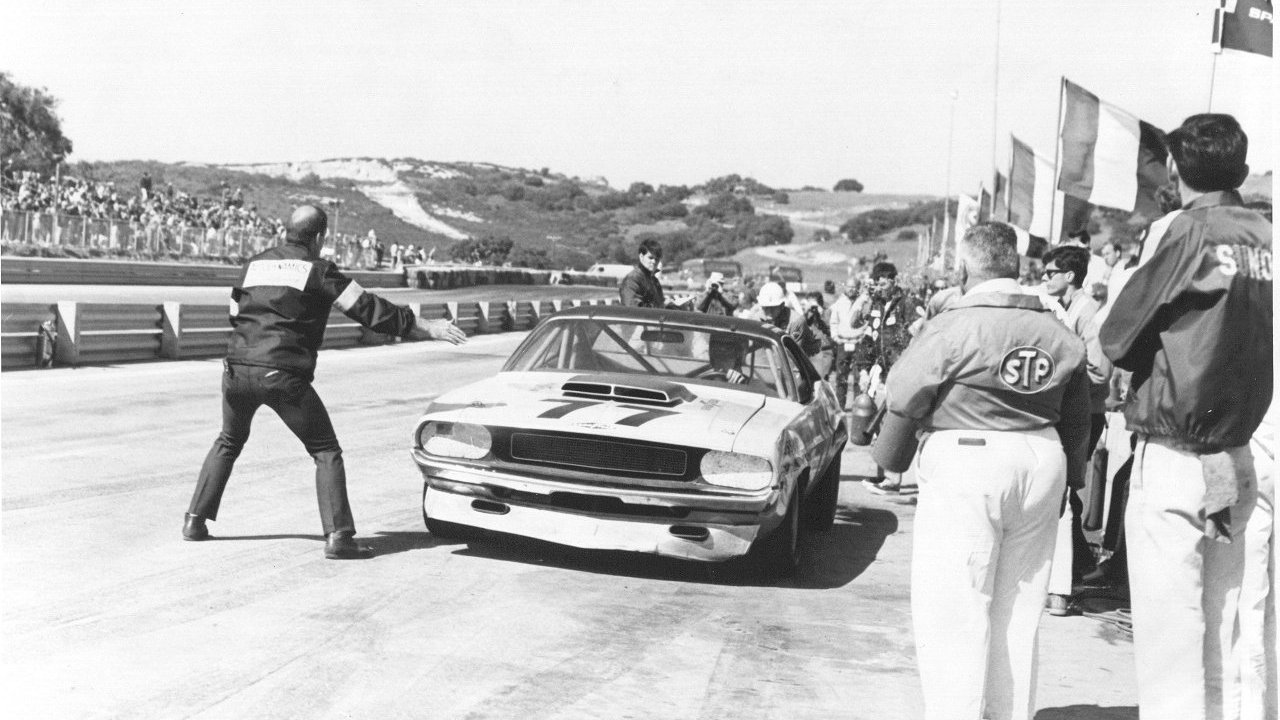
Sports Car Graphic’s Jerry Titus—who had been racing a similar B-production Shelby GT-350 in SCCA Nationals and who knew the 2.6-mile Riverside short course like the back of his driving gloves—qualified on the Pole and won by 48 seconds over Bob Tullius/Tony Adamowicz in the Group 44 Dart. Mustang had won the 1966 Trans-Am Championship!
This first Trans-Am season was often rawly amateur, but with moments of brilliance. Total spectator attendance for all seven races put together was only 31,000; the total purse for seven races was $35,650. On the other hand, nineteen different makes of cars competed, and ten different manufacturers earned Championship points. An average of 33 cars started each event and 240 different drivers drove in at least one 1966 Trans-Am.
Even better, Trans-Am provided exciting, competitive racing, while foreign teams and drivers brought an international perspective. Ford gained priceless publicity for the Mustang, and Alfa could say they’d won an American Championship. Even better, the 1966 Trans-Am set the stage for the incredible boom that was Trans-Am in 1967.
The unbelievable popularity of Trans-Am was due to three things. One, Ford’s new Mustang was the most successful car in history, and every other American manufacturer wanted its own “Pony Car.”
Two, not only was there a Championship for the winning drivers, there was a Manufacturer’s Championship that garnered even more priceless publicity.
Third, and most important, unlike Can-Am and Formula 5000 cars, Trans-Am racers looked like the cars that people actually bought and drove. The only place to race “Pony Cars” was Trans-Am, so every manufacturer spent whatever it took to win on Sunday and sell more cars on Monday. It was that simple!
In his annual In and Out Guide published in the May, 1967 Car and Driver, David E. Davis, Jr. pointed out that “The most In races in the country are the Trans-American sedan races, but the Sports Car Club of America is so Out they don’t know it.” All too true.
Only a few months before David E. published his wisecrack, the SCCA’s new Competition Director, Jim Kaser, announced in Sports Car, the SCCA club magazine, that there would be just eight Trans-Am races in 1967. He also implied that the SCCA would no longer race at Sebring. Kaser was so Out he didn’t know it.
In 1967, the SCCA eventually had to schedule twelve Trans-Ams to accomodate all the tracks that wanted to host an event, including one as a support race for the Sebring 12-Hour. The rules were basically unchanged from 1966, though each manufacturer was allowed to throw out its three worst races when adding up Championship points.
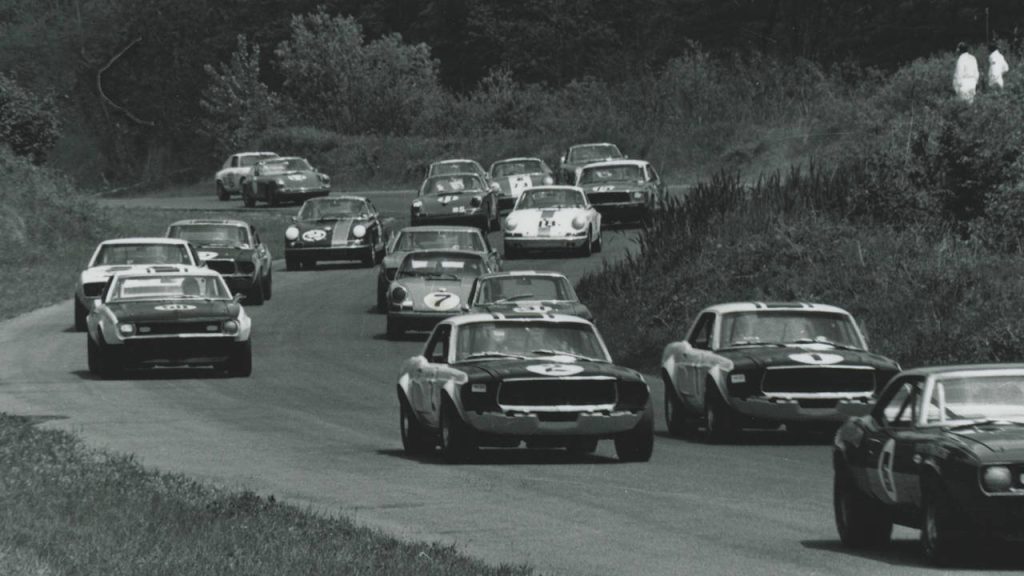
In 1967, Ford actively backed two Carroll Shelby-prepared Mustangs for Jerry Titus and Dick Thompson; Mercury had Bud Moore Cougars for Dan Gurney, Ed Leslie and Parnelli Jones; Chevrolet supported Roger Penske’s Camaro for Mark Donohue. In addition, there were dozens of private owner Camaros and Mustangs—not to mention Bob Tullius’s Dodge Dart—that could, and did, beat the factory teams.
There were also little Alfa Romeos, Lotus-Cortinas and Austin-Coopers. None of them mattered. In the off-season, Porsche had strenuously lobbied the FIA. Their argument was that if Carroll Shelby could take the back seat out of a Mustang sedan to create the GT-350 “sports car,” then why shouldn’t Porsche put a back seat into a 911 sports car to create a “sedan”? Porsche’s instant sedan ran away with the Under 2-liter Trans-Am and trivialized U-2.
In 1966, manufacturers, reporters and fans had treated O-2 and U-2 pretty much equally. Indeed, the enthusiast press had much more respect for a thoroughbred Alfa GTA than for an upstart Mustang that was really just a prettied up Falcon. Starting in 1967, however, the small cars were overlooked in favor of loud, exciting, fender-banging contests between Mustang, Camaro, Cougar, Barracuda, Javelin, Challenger and Firebird.
In 1965, American enthusiasts thought of a sports car as a Ferrari, Jaguar, Triumph or MG. By 1970, a sports car was a Mustang or Camaro. The Trans-Am series, and the factory marketing of that series, was responsible for this paradigm shift in how we define sports car.
Then there are the heros. There were more and better heros back then. The Trans-Am made household names of Roger Penske and Mark Donohue, Bob Tullius and Sam Posey, Swede Savage and Jerry Titus. It added to the reputations of Parnelli Jones and George Follmer and Bud Moore; it almost destroyed the driving careers of Dan Gurney and Ronnie Bucknum and Jim Hall. Trans-Am’s success even made the reputation of SCCA Executive Director John Bishop, and in a very direct way led to his founding of IMSA.
The Golden Era of Trans-Am from 1966 through 1972 was simply the best road-racing series of all time. The cars, the drivers, the unlimited budgets and factory teams…everything was world-class. Trans-Am captured the public imagination like nothing else. Why, Pontiac even named a car after it and paid millions to SCCA for the privilege! As Trans-Am celebrates 60 years since that first race at Sebring, to men of a certain age, Mark Donohue driving a Sunoco Blue Camaro is still what racing is all about. Who are we to say they’re wrong?